
NMPA approves first bispecific antibody-drug conjugate: a new treatment for nasopharyngeal carcinoma
- Iza-bren is the first approved bispecific antibody-drug conjugate in the world. The drug was approved by NMPA in China for recurrent or metastatic nasopharyngeal carcinoma after prior chemotherapy and PD-1/PD-L1 inhibitor therapy.
- In the phase III clinical trial demonstrated a confirmed objective response rate of 54.6%, more than doubling that of chemotherapy. Treatment with iza-bren nearly doubled median progression-free survival to 8.4 months and reduced the risk of progression or death by 56%.
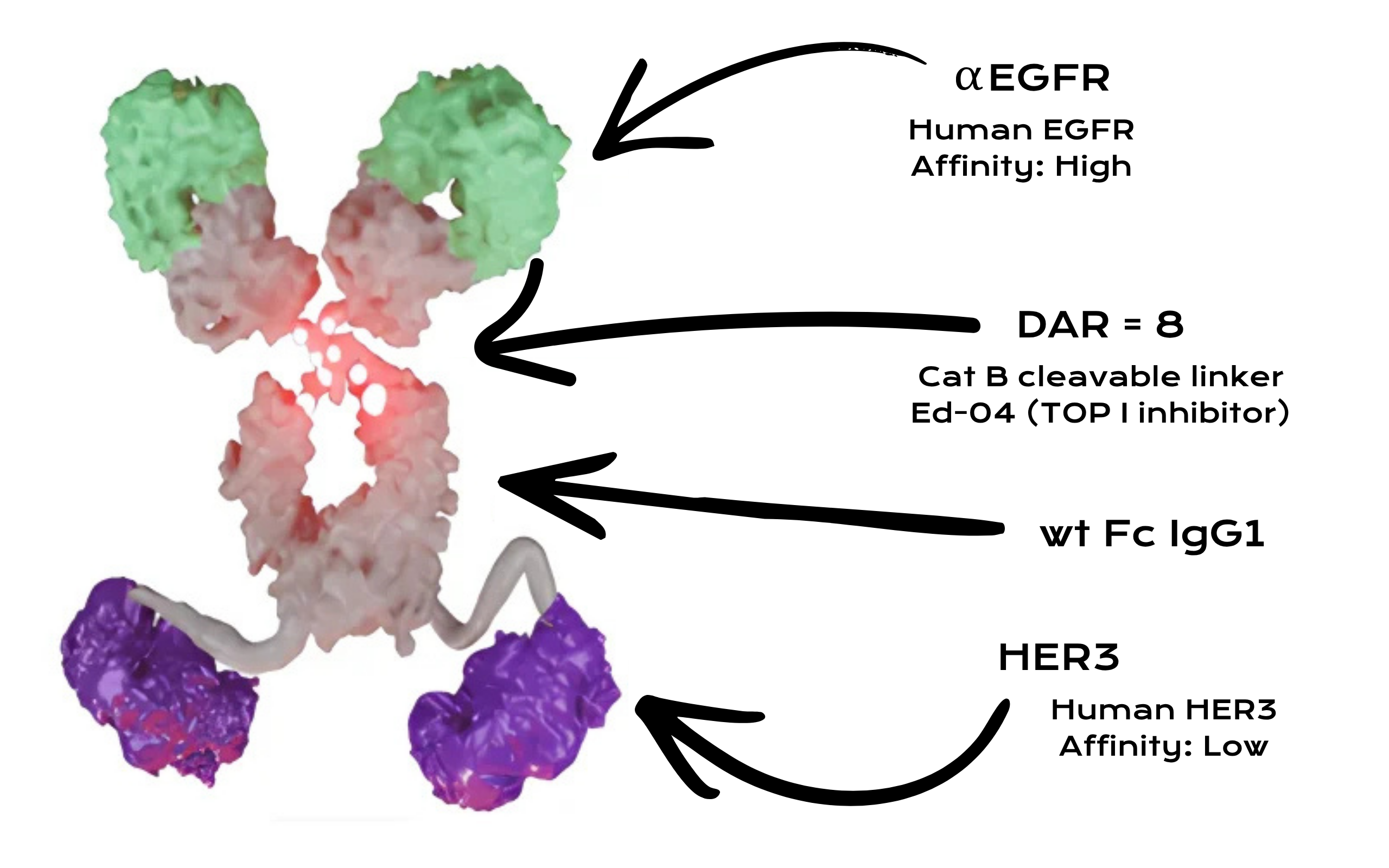
- Iza-bren targets both EGFR and HER3, making it a dual-targeting ADC rather than a conventional monospecific ADC. Its payload is a topoisomerase-I inhibitor designed to induce lethal DNA damage after internalization into tumor cells. A high drug-to-antibody ratio (DAR) of 8 ensures high cytotoxic potency while minimizing off-target skin toxicity.
- The approval of iza-bren creates a new development pathway for biopharma companies seeking to build bispecific antibody-drug conjugates for other solid tumors.
Bispecific Antibody-Drug Conjugate
On June 22, 2026, the National Medical Products Administration (NMPA) of China officially approved iza-bren (izalontamab brengitecan), marking a historic milestone as the world’s first approved bispecific antibody-drug conjugate (BsADC). Developed by Biokin Pharmaceutical, this first-in-class therapeutic represents a revolutionary advancement in anticancer drug formulation, combining the precision of bispecific antibodies with the potent cell-killing power of traditional ADCs. Its arrival signals the beginning of a new era in oncology, offering a disruptive breakthrough for patients whose treatment options were previously exhausted. The drug is specifically indicated for adult patients with recurrent or metastatic nasopharyngeal carcinoma (NPC) who have failed at least two prior lines of systemic chemotherapy and PD-1/PD-L1 inhibitor therapy.
Nasopharyngeal carcinoma is a geographically concentrated malignancy, especially relevant in southern China and Southeast Asia, and is strongly associated with Epstein-Barr virus infection. Patients with recurrent or metastatic disease after platinum chemotherapy and immune checkpoint inhibition often face poor prognosis, with five-year overall survival rates often falling below 10% after initial treatment failure. However, the approval of this bispecific antibody-drug conjugate addresses this critical unmet medical need and provides a great hope for survival benefits.
Mechanism of Action of the Bispecific Antibody-Drug Conjugate
Iza-bren is an EGFR×HER3 bispecific antibody-drug conjugate. Its antibody component recognizes both epidermal growth factor receptor (EGFR) and human epidermal growth factor receptor 3 (HER3). These two receptors that are frequently expressed in epithelial cancers and are implicated in tumor-cell proliferation, survival signaling, therapeutic resistance, and antigen heterogeneity. Simultaneous EGFR/HER3 targeting may reduce dependence on a single antigen and help address resistance pathways that can limit monospecific agents.
The ADC component carries a Ed-04 payload (highly potent topoisomerase-I inhibitor) connected through a cleavable linker. Its high drug-to-antibody ratio (DAR) of 8 ensures that each molecule delivers a potent dose of cytotoxic molecules directly into the tumor. This combination gives the molecule two layers of anticancer activity: receptor-level pathway interference and intracellular release of a DNA-damaging cytotoxic agent.
Iza-bren works through the following sequence:
- The bispecific antibody binds EGFR and/or HER3 on the tumor-cell surface.
- Dual-antigen recognition increases the probability of tumor-cell binding in heterogeneous cancers.
- Receptor engagement promotes internalization of the antibody-drug conjugate.
- Intracellular processing cleaves the linker and releases the topoisomerase-I inhibitor payload.
- Payload-mediated DNA damage induces cytotoxic stress and tumor-cell death.
- A strong bystander effect allows the released payload to eliminate neighbouring tumor cells, even those with low or absent target expression.
Clinical Trial Results of the Iza-bren
The NMPA’s approval was primarily supported by the pivotal Phase III PANKU-NPC 01 study, which was the world’s first confirmatory trial for later-line NPC treatment. In this randomized study involving 386 patients, iza-bren demonstrated substantial clinical superiority over standard chemotherapy options. The bispecific antibody-drug conjugate achieved a confirmed objective response rate (cORR) of 54.6%, more than doubling the 27.0% seen with physician-selected chemotherapy.
Further efficacy data revealed that the median progression-free survival (mPFS) for iza-bren was 8.4 months, nearly twice the 4.3 months observed in the chemotherapy group, with a 56% reduction in the risk of disease progression or death. The safety profile was described as manageable and predictable, with only 2.6% of patients discontinuing treatment due to adverse events, which were primarily hematologic.

Reflecting these compelling results, the NMPA granted approval in just six months from application acceptance. Iza-bren approval validates a new anticancer drug format. A dual-targeting antibody combined with a cytotoxic payload are designed to attack malignant cells more selectively than conventional chemotherapy. Iza-bren has been recommended as a preferred second-line treatment in the 2026 CSCO and NCCN (China Edition) clinical guidelines.
Implications for Biopharma
For biopharma market, iza-bren is a proof-of-concept moment for the bispecific antibody-drug conjugates field. The approval shows that regulators can accept a molecule that integrates three complex design elements: bispecific antigen recognition, linker-payload engineering, and ADC manufacturing control. This is not a routine formulation achievement.
The strategic implications are already visible. Massive USD 8.4 billion partnership between Biokin Pharmaceutical and Bristol-Myers Squibb (BMS) set a new global record for a single ADC transaction at the time. Iza-bren is being developed in collaboration with BMS outside mainland China, and its clinical program extends beyond NPC across more than 40 clinical trials for into cancers such as:
- triple-negative breast cancer
- esophageal squamous cell carcinoma
- non-small cell lung cancer
- urothelial carcinoma
- ovarian cancer
- solid tumors
Prepared by:

Marketing Specialist
Sources and further reading
- Tsuchikama K, Anami Y, Ha SYY, Yamazaki CM. Exploring the next generation of antibody-drug conjugates. Nat Rev Clin Oncol. 2024; 21(3): 203-223.
- Bristol Myers Squibb .Izalontamab Brengitecan (Iza-Bren) Demonstrates Statistically Significant and Clinically Meaningful Improvements in Overall Survival and Progression-Free Survival in Patients with Triple-Negative Breast Cancer and Esophageal Squamous Cell Carcinoma. Press release. 2026.
- Serani S. Bispecific ADC Iza-Bren Extends Survival in Advanced TNBC. Targeted Oncology. 2026.
- Hong SD, Wang YS, Zhao HY, Zhao YY, Wang QM, Ma YX, Li YS, Huang Y, Yang YP, Fu ZM, Chen LK, Zhou F, Yang J, Li XY, Hou X, Zhou NN, Sun LH, Zhang GF, Cui JW, Wu L, Chen G, Zhang YX, Wang HY, Lv DQ, Shi JH, Jiang B, Li C, Li XL, Tang KJ, Yu Y, Ji YH, He ZY, Zhu Y, Zhu H, Xiao S, Zhou CC, Zhang L, Fang WF. Izalontamab brengitecan (Iza-bren; BL-B01D1), a first-in-class EGFR-HER3 bispecific antibody-drug conjugate, for patients with EGFR-mutated NSCLC: pooled analysis of phase I and phase II trials. Ann Oncol. 2026; 37(6): 813-824.
- Wu J, Zhang J, Ouyang O, Du Y, Shi Y, Zhang Q, Liu X, Xie W, Tan A, Li H, Tian C, He L, Zhang H, Wang H, Zhou D, Xiao S, Zhu H, Zhu Y. Izalontamab brengitecan (iza-bren) versus physician’s choice of chemotherapy in patients with unresectable locally advanced or metastatic triple-negative breast cancer (TNBC): a randomized phase III study. J Clin Oncol. 2026; 44(suppl 17): LBA1003.