
Bioprocess Optimization Across Upstream and Downstream Processing
- Bioprocess optimization in biologics manufacturing is the conversion of biological variability into a controllable and reproducible manufacturing process.
- The central objective is to establish a process that consistently delivers drug substance with predefined critical quality attributes (CQAs) under a justified control strategy.
- Bioprocess optimization connects clone selection, cell culture optimization, harvest, clarification, capture, polishing, viral safety, formulation interface, analytical control, and GMP readiness into one development logic rather than a sequence of disconnected experiments.
Scope and Objectives of Bioprocess Optimization in Biologics Manufacturing
The scope of bioprocess optimization in biologics manufacturing extends across the full drug substance workflow. In upstream processing, optimization focuses on the biological production environment. In downstream processing, optimization focuses on converting harvested cell culture fluid into a purified and well-characterized drug substance. For biologics the upstream and downstream scopes cannot be separated because product quality can be lost across the entire process. A complete optimization program contributes to the final quality of the biologic.
The primary goals of bioprocessing optimizing are to increase process productivity, improve product quality, strengthen process robustness, and establish a scientifically justified control strategy suitable for GMP biologics manufacturing. A central goal is to define the relationship between critical process parameters (CPPs), material attributes, and CQAs so that manufacturing performance can be predicted and controlled. Optimization also seeks to reduce cost and shorten cycle time.1
Interdependencies Between Upstream and Downstream Processing
The most consequential interdependencies in bioprocess optimization usually arise from product quality attributes that are formed or biased upstream but revealed or amplified downstream. The upstream and downstream halves of a biologics process are often organized by different teams, equipment, timelines, and performance metrics, but the molecule experiences them as one continuous physicochemical journey.
Upstream processing determines not only how much product enters the recovery train but also the composition, stability, and separability of that product. A high-titer harvest may carry increased cell debris, host-cell proteins, DNA, lipids, antifoam residues, proteases, leached media components, or subvisible particles if the culture is pushed beyond its optimal physiological window. These components can increase clarification burden, reduce filter capacity, foul chromatography media, complicate viral filtration, increase cleaning challenges in stainless-steel systems, or reduce the lifetime of expensive affinity resins.2
Conversely, an upstream process with slightly lower titer but improved viability, reduced lysis, lower turbidity, and a more favorable impurity profile may produce a better overall cost of goods because downstream yield and facility throughput improve. Reviews of monoclonal antibody recovery emphasize that harvest, Protein A capture, and polishing steps are strongly affected by upstream-derived impurity load and product-related heterogeneity.
Optimizing Upstream Conditions for Improved Downstream Performance Programs
Upstream parameters have a significant impact on the purification of biologic drugs. They should be monitored not only for their effects on cell growth and productivity. Effective bioprocess optimization also requires evaluating culture composition, impurity burden, and product heterogeneity.3
For therapeutic proteins production in mammalian cells, the most critical parameters include:
- Base medium composition
- Amino acid supplementation
- Trace elements
- Glucose control
- Dissolved oxygen
- pH
- Temperature variation
- Agitation
- Inoculation density
- Culture duration
Each of these factors can alter the environment in which the protein is expressed. Upstream process parameters influence protein folding, post-translational modification, secretion, and degradation pathways. As a result, upstream conditions can affect:
- Charge variants
- Aggregation propensity
- DNA fragmentation
- Host cell protein release
- Host cell DNA burden
Substance behavior during viral filtration, chromatography, ultrafiltration, and diafiltration is largely determined by its purity profile. Initial clarification and purification immediately after harvest are not always capable of correcting product quality issues arising from an unfavorable impurity profile. Consequently, cell culture development is routinely evaluated not only in terms of yield but also with respect to product quality attributes. In many cases, a CHO cell line that delivers consistent yields while producing less heterogeneous monoclonal antibodies may offer greater overall value than a more productive cell line that introduces multiple post-translational variants into the drug product.4
A useful case study is inoculation density, because it shows how a single upstream parameter can alter multiple downstream challenges at once. When inoculation density is increased, the production culture may reach high viable cell density more rapidly, compressing the growth phase and potentially increasing early volumetric productivity. This can be attractive for manufacturing because it may shorten bioreactor occupancy and improve facility utilization, particularly in intensified fed-batch or seed-train bioprocess optimization programs.5
However, the downstream consequences depend on whether nutrient supply, oxygen transfer, carbon dioxide stripping, pH control, and feed timing have been redesigned to match the higher starting biomass. If the process is not rebalanced, a high inoculation density can accelerate glucose and amino acid consumption, increase lactate or ammonia accumulation, raise osmolality, and intensify oxygen and carbon dioxide control demands. These stresses can reduce late-culture viability and increase the release of host-cell proteins, host-cell DNA, lipids, proteases, and fine particulates into the harvested cell culture fluid. During purification, this can reduce depth-filter capacity, increase turbidity entering capture chromatography, promote resin fouling, and raise the burden on polishing steps intended to remove persistent host-cell proteins or product-associated impurities.
Inoculation density can also shift product quality by changing growth-rate-dependent metabolism, culture age at harvest, and exposure time to intracellular or extracellular degradation pathways. In bioprocess optimization, the optimal inoculation density is therefore not the highest density that supports rapid production, but the density that produces a harvest with acceptable titer, viability, impurity profile, product-quality distribution, and downstream processability.6
Downstream Optimization Strategies for Yield and Purity Enhancement
Downstream development and optimization transforms a complex biological harvest into a drug substance that meets purity, potency, safety, and stability requirements.
In monoclonal antibody processes, a typical platform includes:
- Harvest Clarification
- Protein A Capture
- Low-pH viral inactivation
- Polishing Chromatography
- Viral filtration
- Ultrafiltration-Diafiltration
- Final bulk filtration.
Other biologics may require:
- Mixed-mode Chromatography
- Hydrophobic Interaction Chromatography
- Membrane Chromatography
- Specific Affinity Chromatography
The optimization objective is to maximize recovery while achieving clearance of process-related impurities, product-related impurities, adventitious agents, and residual contaminants..
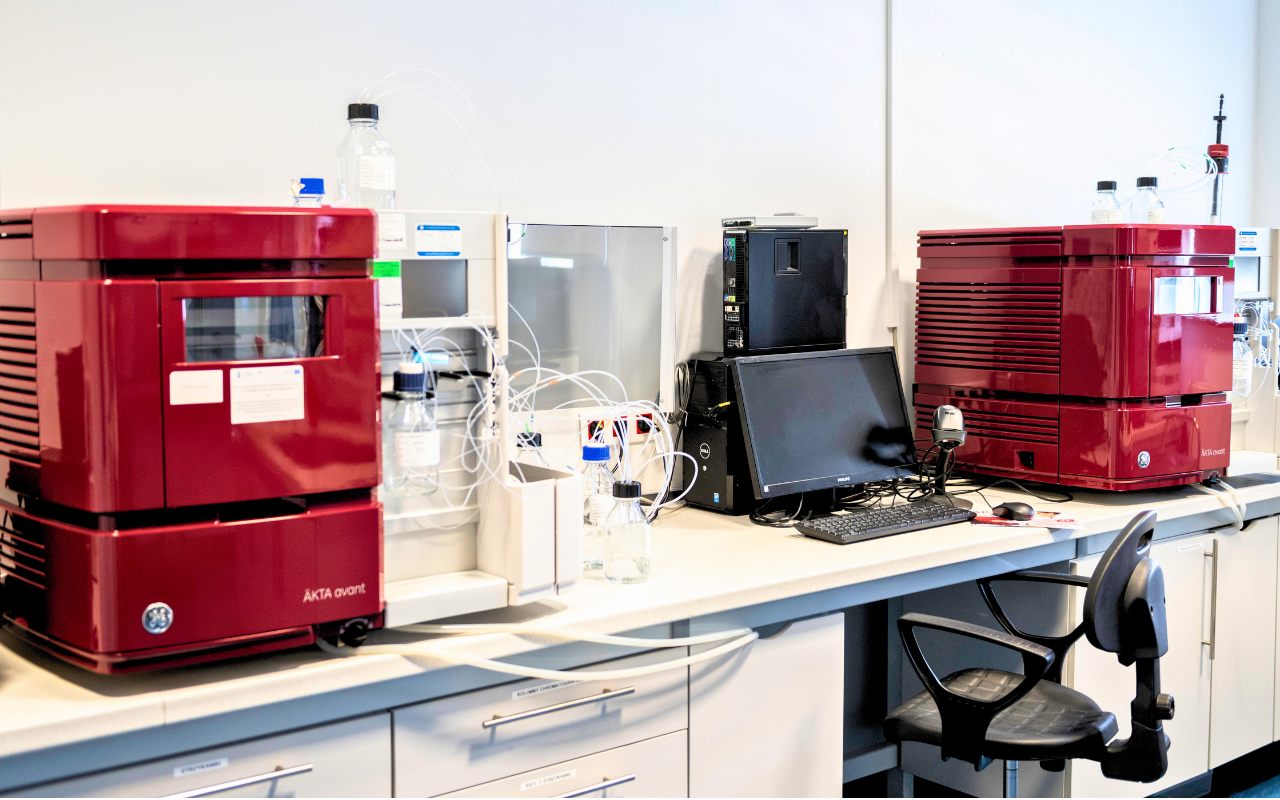
Clarification is the first downstream operation and often determines whether the purification train begins with a stable or compromised feed stream. Depth filtration, centrifugation, microfiltration, flocculation, and staged filtration can remove cells, viruses, debris, colloids, and some host-cell impurities before chromatography.7
Upstream harvest quality strongly affects clarification performance, which is why upstream viability and lysis control are key variables in bioprocess optimization. In high-density fed-batch or perfusion cultures, the clarification challenge can become acute because solids loading, submicron particles, and cell debris may exceed platform assumptions.
Polishing chromatography is where the process resolves many of the most consequential residual risks. Depending on the resins used and the mechanism of action, cation exchange, anion exchange, hydrophobic interaction, hydroxyapatite and multimodal chromatography are distinguished.
Ensuring the viral safety of a biologic drug is critical from the patient’s perspective. These requirements are outlined in the ICH Q5A(R2) guidelines, which provide recommendations for viral safety assessment, including cell substrate qualification, testing strategies, and viral clearance studies for biotechnology-derived products produced from characterized cell lines. GMP manufacturing integrates dedicated viral reduction and removal steps into the purification process.
Low-pH viral inactivation can affect protein aggregation, fragmentation, and charge heterogeneity. Therefore, neutralization conditions and mixing strategies must be carefully designed to ensure both viral safety and product stability. Viral filtration is highly sensitive to feed quality, aggregate levels, pressure, flow rate, protein concentration, and impurity burden, once again linking the performance of upstream processing and polishing steps to the final assurance of product safety.8
Data Integration and Process Analytics in Bioprocess Optimization
Data integration is the mechanism by which bioprocess optimization moves from empirical improvement to predictive control. Modern biologics development generates data from several stages. Without integration, these datasets remain fragmented and may produce misleading conclusions. With integration, developers can model how process parameters propagate through the process to affect quality, yield, and robustness. This is the foundation of a control strategy because it identifies which variables require tight control, which require monitoring, and which are merely supportive.
Comprehensive characterization is the analytical backbone that makes data integration meaningful. For biologics characterization should connect structure, purity, potency, and phisicochemical attributes through orthogonal methods.9
Designing Integrated Bioprocess Optimization Strategies for GMP Manufacturing
An integrated GMP optimization strategy begins with the end state and works backward. The desired end state is a validated, controllable, commercially suitable process that consistently produces drug substance meeting specifications and CQA expectations. To reach that state, development teams should define the target product quality profile, identify potential CQAs, map process parameters and material attributes to those CQAs, and establish a risk-ranked development plan. The plan should include upstream development, downstream platform, analytical, formulation-interface, facility-fit, raw-material, and supply-chain considerations. It should also specify how knowledge will mature from exploratory screening to process characterization, process performance qualification, and continued process verification.
FAQ
Prepared by:

Marketing Specialist
References
- Williamson K. Efficiency in Bioprocessing: Unveiling Upstream and Downstream Operations. Pharma Focus Europe. 2024.
- Gagnon P. Taming the Last Frontier: Harmonizing the Upstream-Downstream Interface. Cell Gene Ther. Insights. 2019; 5(3), 411-414.
- Liu HF, Ma J, Winter C, Bayer R. Recovery and purification process development for monoclonal antibody production. MAbs. 2010; 2(5): 480-499.
- Yang CH, Li HC, Lo SY. Enhancing recombinant antibody yield in Chinese hamster ovary cells. Tzu Chi Med J. 2024; 36(3): 240-250.
- Kikuchi T, Ohira S, Yamaguchi H. Viable cell density as an indicator for dynamic feeding strategy in fed-batch and perfusion CHO cell culture. Sci Rep. 2025; 15: 44714.
- Guajardo N, Schrebler RA. Upstream and Downstream Bioprocessing in Enzyme Technology. Pharmaceutics. 2023; 16(1): 38.
- Singh N, Arunkumar A, Chollangi S, Tan ZG, Borys M, Li ZJ. Clarification technologies for monoclonal antibody manufacturing processes: Current state and future perspectives. Biotechnol Bioeng. 2016; 113(4): 698-716.
- Jin W, Xing Z, Song Y, Huang C, Xu X, Ghose S, Li ZJ. Protein aggregation and mitigation strategy in low pH viral inactivation for monoclonal antibody purification. MAbs. 2019; 11(8): 1479-1491.
- Knurek J. Biologics Characterization for Ensuring Product Quality and Consistency. Mabion Science Hub. 2025.