
Biosimilars Regulatory Requirements in Global Markets
- Biosimilar development is based on demonstrating high similarity to a licensed reference biological product.
- Global regulators generally apply a stepwise “totality of evidence” model, beginning with extensive analytical comparability and moving to targeted non-clinical and clinical studies only where residual uncertainty remains. All regulatory agencies require robust quality, manufacturing, pharmacovigilance, and comparability evidence, but differ in reference-product expectations, clinical-study flexibility, interchangeability language, and local procedural requirements.
- Harmonization is increasingly shaped by ICH quality guidelines, WHO biosimilar principles, and ICMRA confidence-building initiatives.
Biosimilars Regulatory Frameworks Across Global Markets
Across major markets, regulators expect a comparability between biosimilar and originator.
- EMA describes the biosimilar approach as establishing similarity in molecular and biological terms to the active substance of the reference medicinal product.
- FDA requires evidence that the proposed biosimilar is highly similar to the reference product and has no clinically meaningful differences in safety, purity, and potency.
This approach is strongly aligned with the scientific assumptions of ICH Q5E, which established the concept of comparability for biological products. Although ICH Q5E was originally developed for assessing manufacturing changes, its logic supports modern biosimilar regulation. The more sensitive and complete the analytical comparability exercise, the less residual uncertainty should remain for animal or clinical studies. Additional studies should be required only when residual uncertainty remains.1, 2
Key Regulatory Principles Defining Biosimilars Development Pathways
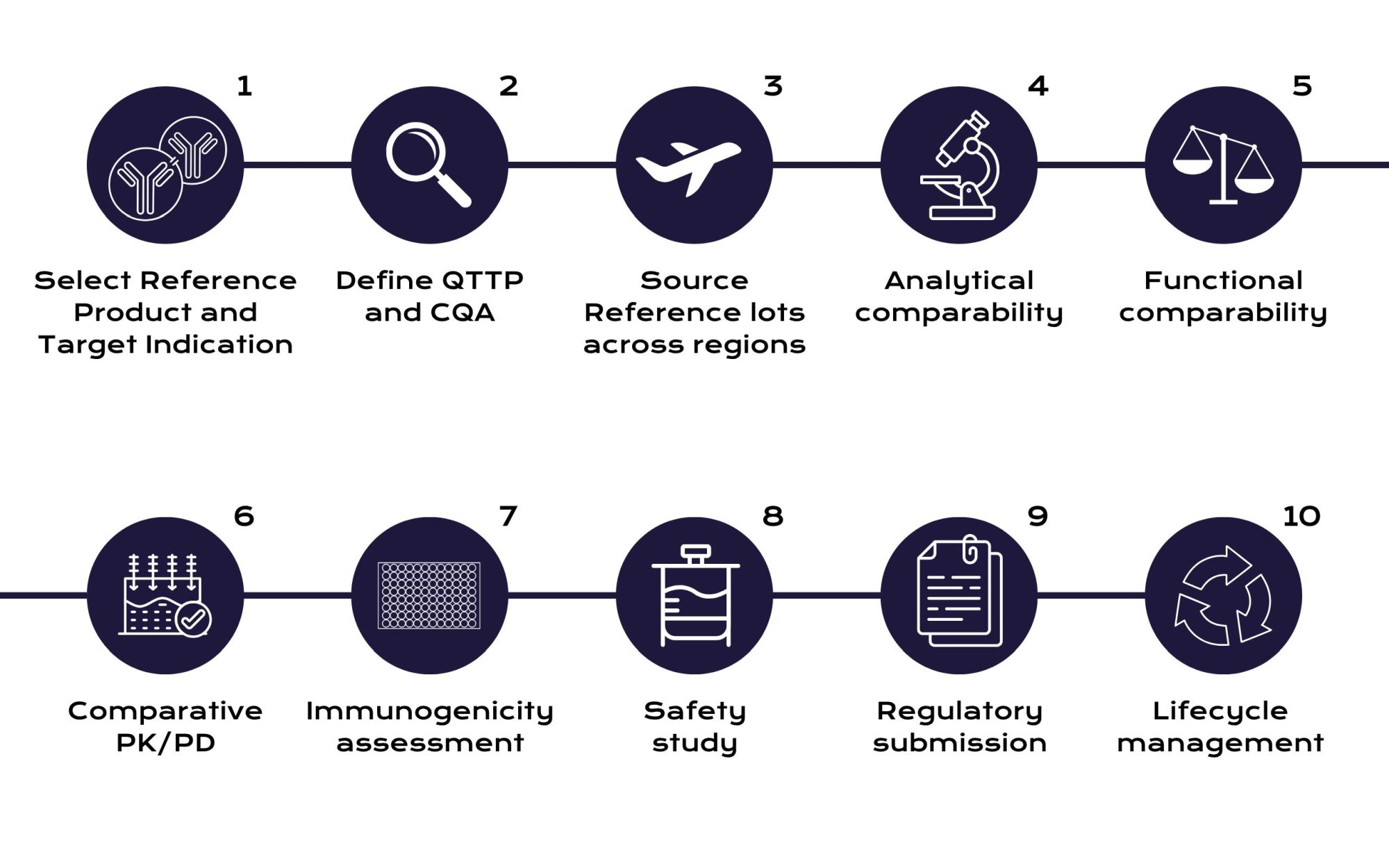
Biosimilar regulatory frameworks are built on the principle that approval should be based on demonstrating high similarity to an already authorized reference biological product. The general biosimilar development pathway is risk-based. It starts with product selection and reference-product strategy. The pathway proceeds through deep analytical and functional characterization, then uses non-clinical and clinical studies only to answer remaining scientific questions.3
For complex biologics regulators expect particular attention to primary structure, higher-order structure, glycosylation, charge variants, purity, impurities level, Fc-mediated functions, binding, potency, degradation pathways, and stability.
Analytical and Clinical Requirements in Biosimilars Regulatory Submissions
Analytical characterization is the core of both FDA and EMA biosimilars regulatory submissionss. Comparative analytical studies and toxicity assessment are used by FDA to decide whether residual uncertainty remains and whether comparative efficacy studies are necessary. EMA similarly requires a full quality dossier plus comparability data using appropriate physicochemical, in vitro biological, non-clinical, and clinical studies. For monoclonal antibodies, this means using multiple orthogonal techniques to evaluate critical quality attributes (CQAs).4
Clinical requirements are intentionally focused. FDA and EMA generally expect comparative human PK as a sensitive clinical confirmation of similarity; PD may be used when a relevant, sensitive biomarker exists. Immunogenicity assessment remains important because small differences in product- or process-related attributes can influence anti-drug antibody formation, neutralizing antibodies, hypersensitivity, loss of efficacy, or altered clearance.3,5
But comparative efficacy studies are no longer viewed as automatically necessary in every case. A major emerging trend is the move toward a more tailored clinical approach in biosimilar development. Under this model, large comparative efficacy trials are no longer treated as a default requirement when robust analytical, functional, PK, PD, safety, and immunogenicity data sufficiently support biosimilarity.6
EMA has described this approach as a way to optimize biosimilar development while reducing the amount of clinical data required, and FDA’s updated draft recommendations similarly reflect evolving biosimilars regulatory requirements by focusing on when comparative efficacy studies are scientifically necessary. This evolution may significantly reduce development timelines, clinical trial burden, and overall costs, while maintaining regulatory confidence in biosimilar quality, safety, and efficacy.
Regulatory Expectations for Biosimilar Manufacturing and Process Control
Manufacturing expectations are shaped by the broader ICH quality framework. It establishes specification parameters for drugs and promotes quality risk management and pharmaceutical quality systems.7,8
For biosimilars, this translates into a control strategy that links process knowledge to CQAs and clinical relevance. Regulators expect:
- Validated manufacturing processes
- Control of cell banks and raw materials
- Viral safety
- Contamination control
- In-process control
- Release specifications
- Comparability after process changes
- Stability programs
- Lifecycle management
In the manufacturing of biosimilars, the manufacturer does not need to copy the originator’s process, but must consistently manufacture a product that remains highly similar to the reference product.
Regional Differences in Biosimilar Regulatory Approaches
Biosimilars regulatory requirements differ by region because each agency applies its own legal pathway, dossier format, comparator expectations, review procedure, terminology, and post-approval obligations.
MHRA (United Kingdom)
MHRA has its own guidance for licensing biosimilar products in Great Britain and the UK, updated after Brexit and the Windsor Framework.9 A notable UK differentiator is its explicit position that, once authorized, a biosimilar is considered interchangeable with its reference product and with other biosimilars to the same reference product, while prescribing decisions remain under healthcare-professional control.
PMDA (Japan)
Japan defines a biosimilar as a product comparable in quality, safety, and efficacy to a biotechnology-derived product already approved in Japan as an original biopharmaceutical. PMDA guidance and Q&A documents emphasize quality comparability, Japanese regulatory expectations, and case-by-case justification of clinical data, including how comparative efficacy studies may be used to address remaining quality-attribute differences.10
TGA (Australia)
TGA regulates biosimilars through registration on the Australian Register of Therapeutic Goods and provides guidance on data requirements, reference medicine requirements, in-house primary reference standards, quality comparability, extrapolation, naming, evaluation, and post-registration responsibilities. Australia has adopted relevant EMA biosimilar guidelines, but TGA clarifies that references to EU legislation inside adopted guidelines do not automatically apply to Australian evaluations.11
NMPA (China)
China’s NMPA, through the Center for Drug Evaluation (CDE), has developed biosimilar technical expectations around comparative quality, non-clinical, clinical, and registration requirements. A practical differentiator is the importance of China-specific CDE technical guidance, local submission procedures, and evolving labeling expectations for biosimilars, including clearer identification of biosimilar status in product information.12
ANVISA (Brazil)
Brazil historically regulated follow-on biological products under RDC 55/2010, which created pathways including development by comparability. In 2024, ANVISA issued RDC 875/2024 to add provisions for biosimilar registration through the comparability development route, reflecting a move toward more explicit, modernized biosimilar-specific regulation.13
Aligning Biosimilar Development and Manufacturing with Global Regulatory Standards
A global biosimilars regulatory strategy usually follows the most rigorous common denominator across target markets. Sponsors typically design one integrated comparability program that can support all regulatories and WHO-aligned submissions, then add local modules for reference-product bridging, language, labeling, pharmacovigilance, administrative documents, and country-specific clinical expectations.14
Global harmonization is supported by ICH quality guidelines, which provide shared principles for comparability, specifications, risk management, pharmaceutical quality systems, and drug-substance development. WHO’s biosimilar guidelines provide globally acceptable principles for licensing biosimilars and support reliance on originator data once similarity is proven.
FAQ
Prepared by:

Marketing Specialist
References
- Iskit AB. Biosimilars and interchangeability: Regulatory, scientific, and global perspectives. Eur J Pharm Sci. 2025; 213: 107224.
- European Medicines Agency. ICH Q5E Biotechnological/biological products subject to changes in their manufacturing process: comparability of biotechnological/biological products. 2005.
- Kirchhoff CF, Wang XM, Conlon HD, Anderson S, Ryan AM, Bose A. Biosimilars: Key regulatory considerations and similarity assessment tools. Biotechnol Bioeng. 2017; 114(12): 2696-2705.
- Sullivan PM, DiGrazia LM. Analytic characterization of biosimilars. Am J Health Syst Pharm. 2017; 74(8): 568-579.
- Niazi SK. Scientific Justification and Policy Recommendations to the US Food and Drug Administration for Waiving Comparative Efficacy Studies. Pharmaceuticals (Basel). 2025; 18(6): 779.
- Tuszyner A. The New Era of Biosimilar Development: Seizing the Opportunity Under EMA’s Streamlined Guidelines. Mabion Science Hub. 2025.
- European Medicines Agency. ICH Q6B Specifications: test procedures and acceptance criteria for biotechnological/biological products. 1999.
- European Medicines Agency. ICH Q9 Quality risk management. 2025.
- Medicines and Healthcare products Regulatory Agency. Guidance on the licensing of biosimilar products. 2025.
- Pharmaceuticals and Medical Devices Agency. Guideline for Ensuring Quality, Safety, and Efficacy of Biosimilars. 2020.
- Therapeutic Goods Administration. Registering a biosimilar medicine in the Australian Register of Therapeutic Goods (ARTG) Guidance on how to apply to register a biosimilar medicine on the Australian Register of Therapeutic Goods (ARTG) and ongoing sponsor responsibilities. 2013.
- Liu Y, Zhang N, Xie C, Jiang Y, Qin Y, Zhou L, Fan Y, Ren L, Yin C, Yang H, Xie W, Zhai Q, Li G, Chen H, Chen X. Evolution of drug regulations and regulatory innovation for anticancer drugs in China. Acta Pharm Sin B. 2022; 12(12): 4365-4377.
- Agência Nacional de Vigilância Sanitária. Resolution of the Collegiate Board of Directors (RDC) biosimilars regulations. 2024.
- Umaru OT, Adeyemi AS, Aderonmu O, Bhangu BS, Dhaliwal HS, Lim H, Aremu TO. Global Pharmaceutical Regulation: Comparative Frameworks and Operations. Pharmacy (Basel). 2026; 14(2): 50.