
The Role of High-Throughput Screening (HTS) in Cell Line Development and Process Optimization
- High-throughput screening has become the accelerant of modern biologics development, reshaping how scientists design, evaluate, and optimize mammalian production systems while compressing timelines that once stretched into years.
- We offer an integrated high-throughput and automated platform for development of manufacturing cell lines for the production of protein therapeutics.
Why High-Throughput Screening Is Transforming Cell Line Development?
In biopharma, speed is not a luxury; it is a competitive advantage. High-throughput screening has emerged as one of the most influential enablers of this advantage, fundamentally redefining how cell line development biologics programs are executed. Traditional workflows relied on incremental experimentation, manual handling, and limited datasets. These approaches were scientifically sound but painfully slow, often forcing development teams to make high-stakes decisions based on narrow snapshots of biological behavior.
High-throughput screening changes the psychology of development. Instead of asking whether a handful of clones perform well, scientists can now ask how thousands behave under subtly different conditions. HTS cell line development platforms allow parallelized experimentation at a scale that mirrors the complexity of living systems. The result is not merely faster data generation but better decision-making, driven by statistically robust insights rather than intuition.
What makes high-throughput screening so compelling is its ability to surface hidden relationships between genotype, phenotype, and process conditions. Minor variations in media composition, feeding strategy, or culture environment can have outsized effects on productivity and product quality. HTS makes these effects visible early, when course correction is still inexpensive. This capability has elevated HTS from a tactical tool to a strategic pillar of biologics manufacturing expertise.1
High-Throughput Screening in Mammalian Cell Line Development
Mammalian cell lines biologics development sits at the intersection of molecular biology, bioengineering, and manufacturing science. High-throughput screening thrives in this intersection. By miniaturizing experiments into microtiter plates or advanced micro-bioreactor systems, HTS enables simultaneous interrogation of hundreds or thousands of cell populations under tightly controlled conditions.
In stable cell line development, the early stages are often the most uncertain. Transfection efficiency, genomic integration patterns, and epigenetic effects introduce variability that can take months to resolve using conventional methods. HTS shortens this uncertainty window. Screening large clone pools early allows development teams to rapidly converge on high-performing candidates while eliminating those with undesirable traits such as poor growth kinetics or inconsistent expression.2
Importantly, HTS does not sacrifice biological relevance for speed. Advances in assay design, automation, and data analytics have made it possible to capture complex phenotypes, including secretion rates, metabolic profiles, and stress responses. This depth of insight is essential for mammalian cell lines biologics programs, where productivity alone is not enough. Quality attributes, robustness, and scalability must be baked into the cell line from the start.
CHO Cell Lines as the Industry Standard for Biologic Drug Development
CHO cell line development remains the backbone of modern biologics manufacturing, and high-throughput screening has amplified its strengths. Chinese hamster ovary cells offer a rare combination of genetic stability, regulatory familiarity, and the ability to perform human-compatible post-translational modifications. Yet even within this well-characterized system, variability is the rule rather than the exception.
High-throughput screening allows developers to fully exploit the diversity inherent in CHO populations. Instead of narrowing too quickly to a small number of clones, HTS encourages exploration. This exploration often reveals clones with unexpected advantages, such as superior long-term stability or resilience to process perturbations. In an industry where late-stage surprises can derail entire programs, this early clarity is invaluable.
CHO cell culture development also benefits from HTS-driven media and feed optimization. Subtle shifts in nutrient balance can influence glycosylation patterns, aggregation propensity, and overall yield. High-throughput approaches make it feasible to test dozens of formulations in parallel, accelerating the journey toward a robust, scalable process that aligns with regulatory expectations and commercial realities.3
Applying HTS to Clone Selection, Productivity, and Stability Assessment
Clone selection HTS has become the gold standard for identifying production-ready cell lines. Productivity, once measured in isolation, is now evaluated alongside growth behavior, metabolic efficiency, and genetic stability. High-throughput screening makes it possible to assess these parameters simultaneously, revealing trade-offs that would otherwise remain hidden until late development.
Stability assessment is where HTS truly shines. Long-term expression stability is notoriously difficult to predict, yet it is critical for commercial success. By combining accelerated stability studies with high-throughput analytics, developers can identify clones that maintain performance over extended culture periods. This early confidence reduces the risk of costly re-development during clinical or commercial phases.4
HTS also supports smarter risk management. By generating large datasets across diverse clones, development teams can build predictive models that link early screening results to long-term outcomes. This data-driven foresight transforms cell line development from an art informed by experience into a science guided by evidence.
Integrating HTS with Process Optimization and Upstream Development
High-throughput screening does not end with clone selection. Its real power emerges when integrated into upstream process optimization. HTS process development platforms enable systematic exploration of parameters such as pH, temperature shifts, feeding strategies, and dissolved oxygen levels. Instead of sequential experimentation, teams can map multidimensional design spaces with unprecedented efficiency.5
This integration accelerates biologics process optimization by aligning cell line characteristics with process conditions early. A clone that performs exceptionally under one set of conditions may falter under another. HTS exposes these dependencies before scale-up, reducing the risk of surprises during tech transfer or manufacturing.
Upstream process optimization driven by HTS also supports regulatory strategies. Well-characterized processes with strong scientific rationales are easier to defend during regulatory review. The extensive datasets generated by high-throughput approaches provide exactly this kind of justification, strengthening the overall development narrative.6
Leveraging HTS Expertise in CHO-Based Development Programs at Mabion
At Mabion, high-throughput screening is not treated as a standalone technology but as an integrated component of biologics manufacturing expertise. CHO-based development programs benefit from HTS-enabled workflows that connect cell line development, clone selection, and upstream process optimization into a coherent strategy.

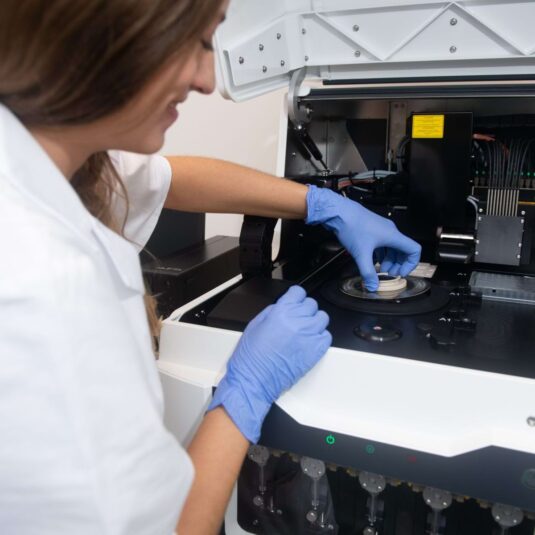
By embedding HTS into CHO cell line development, Mabion accelerates the identification of stable, high-producing clones while simultaneously generating insights that inform process design. This holistic approach reduces development risk, shortens timelines, and creates a smoother path from early research to commercial manufacturing. Our CLD platform is based on the Beacon Select system, which enables the evaluation of multiple therapeutic proteins, including monoclonal antibodies, bispecific antibodies, and other modalities. Selective single-cell cloning can be applied to accelerate cell line development by gently sorting the cell pool as early as 3 weeks post-transfection, even when cell viability is as low as 30%.
In an industry defined by complexity and competition, high-throughput screening offers something rare: clarity. It allows developers to see more, understand more, and decide with confidence. As biologics continue to grow in importance and sophistication, HTS will remain a defining force in how successful therapies are brought to patients.
FAQ
Prepared by:

Marketing Specialist
References
- Ryoo H, Kimmel H, Rondo E, Underhill GH. Advances in high throughput cell culture technologies for therapeutic screening and biological discovery applications. Bioeng Transl Med. 2023; 9(3): e10627.
- Lai T, Yang Y, Ng SK. Advances in Mammalian cell line development technologies for recombinant protein production. Pharmaceuticals (Basel). 2013; 6(5): 579-603.
- Wang B, Albanetti T, Miro-Quesada G, Flack L, Li L, Klover J, Burson K, Evans K, Ivory W, Bowen M, Schoner R, Hawley-Nelson P. High-throughput screening of antibody-expressing CHO clones using an automated shaken deep-well system. Biotechnol Prog. 2018; 34(6): 1460-1471.
- Jones M, Goodyear RL. High-Throughput Purification in Drug Discovery: Scaling New Heights of Productivity. ACS Med Chem Lett. 2023; 14(7): 916-919.
- Łącki KM. High throughput process development in biomanufacturing. Curr. Opin. Chem. Eng. 2024; 6: 25-32.
- Wei F, Wang S, Gou X. A review for cell-based screening methods in drug discovery. Biophys Rep. 2021; 7(6): 504-516.